
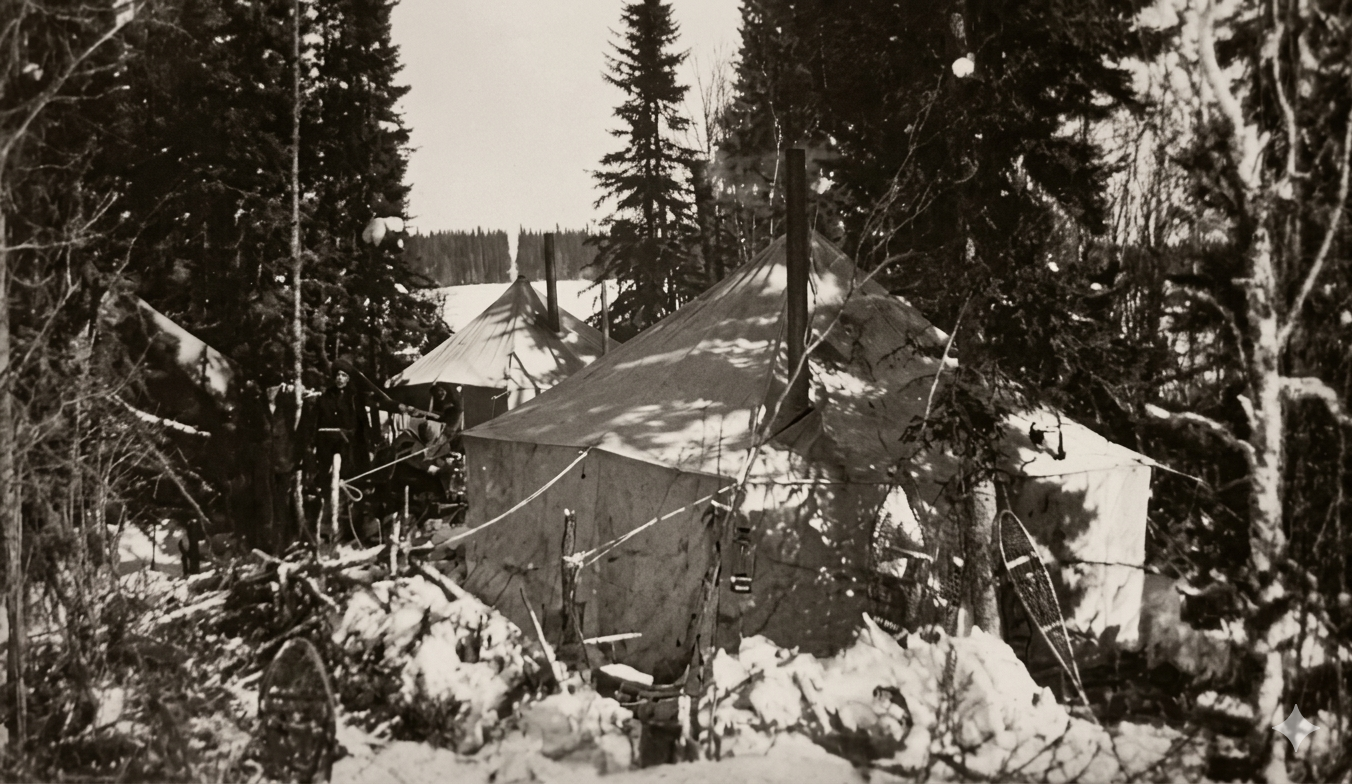
In early August, 1900, Thomas Speight was leading Party No. 1 of the Grand Survey of Northern Ontario. He was running a survey line through the boreal forest, north of Lake Abitibi, about a mile each day. Meanwhile, he had a team of assistants, Algonquin men from Abitibi, Temiskaming, and Mattawa, doing the unsung work of bush life. About every three days, they had to move camp, to stay close to the working end of the line. What gruelling work this must have been!
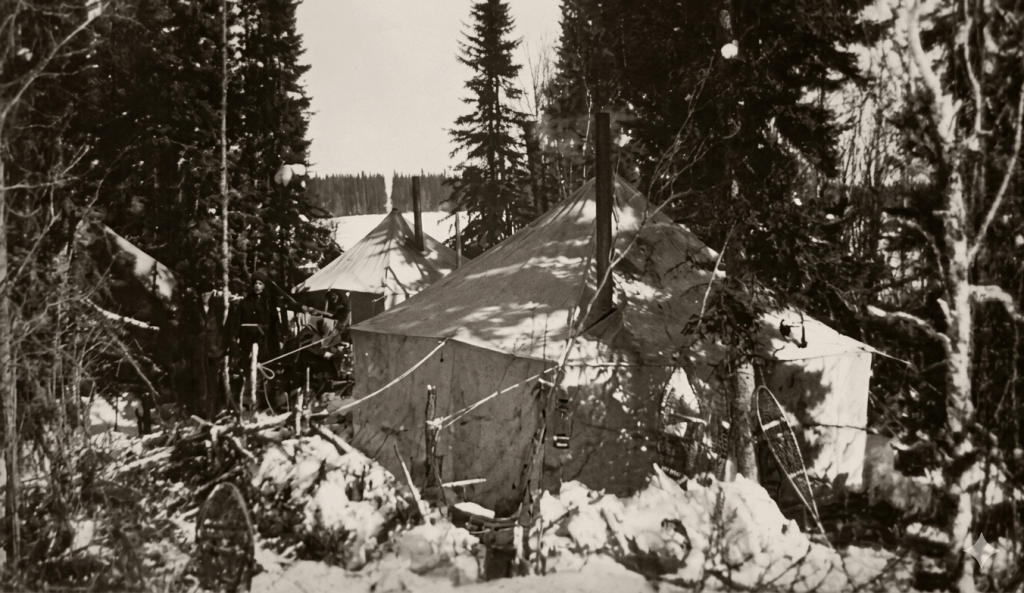
Surveyors’ camp in winter. Photo from Great Lengths: A Celebration of the Surveyors of Ontario by Charles Wilkins (Toronto: Association of Ontario Land Surveyors, 2017), 73.
Every few days, the packers moved camp about three miles, staying near the end of Speight’s line as it pushed toward Quebec. Such an easy sentence to read, but imagine the work that involved!
In the morning, roll up everyone’s wool blankets and pack them into canvas canoe packs. Then strike three or more canvas tents, rolling them carefully, picking out the spruce twigs and chunks of spaghnum moss.
When breakfast is done and the cook has washed the pots, pack all that into wannigans, wooden boxes for kitchen supplies. Lash the wannigan closed with a leather tumpline. Lift the wannigan up to the thighs, easily fifty pounds, and deftly swing it behind while positioning the tumpline over the upper forehead to distribute the weight straight down the spinal column. Heave a canoe pack overhead, another fifty pounds, and guide it to rest in the suspension created by the tumpline. Grab a smaller load, perhaps a packsack or an axe, then start down the line.
Just two days before, this survey line was no more than bush, or muskeg. Today it is a newly cut trail heading east, straight as an arrow, regardless of what obstacles the land might lay out along the way. The axemen have cut back the trees and shrubs so that Thomas Speight can peer through his theodolite toward a marker his assistant, Spencer Holcroft, has set up some distance away. To call this survey line a portage would be discrediting portages, even bad ones.
Carry that load across the duff, moss so cushiony that it might be easier to carry a hundred pounds over an endless mattress. Leg muscles strain, core muscles tense, neck muscles stiff like an iron survey bar. Do this for three miles to the new camp site. Drop the load then enjoy the return trip with nothing on the back. Repeat as necessary, until all the dunnage is across. Don’t forget the canoe, brought along on this overland portage to cross any lakes or rivers that might be encountered.
Once everything is at the new site, trees need to be cut to find a patch of land big enough to pitch three large tents. Some of those trees can be used to pitch the floorless tents, each of which needs seven or more stout poles: two scissor poles on either end, a ridge pole, and two to hold out the sides. Once the tent is up, cut balsam boughs for the floor, hundreds of them, fragrant evergreen branches that give the space a cushiony warmth.
When the tents are up, help the cooks by gathering firewood; find a tall, dead spruce tree with its top intact, indicating that it is not rotten. Cut down the tree, buck it into eight foot cordwood lengths, and carry those back to camp, where they can be cut again to stove lengths and then split to firewood or kindling. Sheer effort. And these are only a few of the jobs necessary in a day in the life of a packer on a survey crew. The land will not submit easily to the colonial frame.
 History by Canoe